MAPR 2026
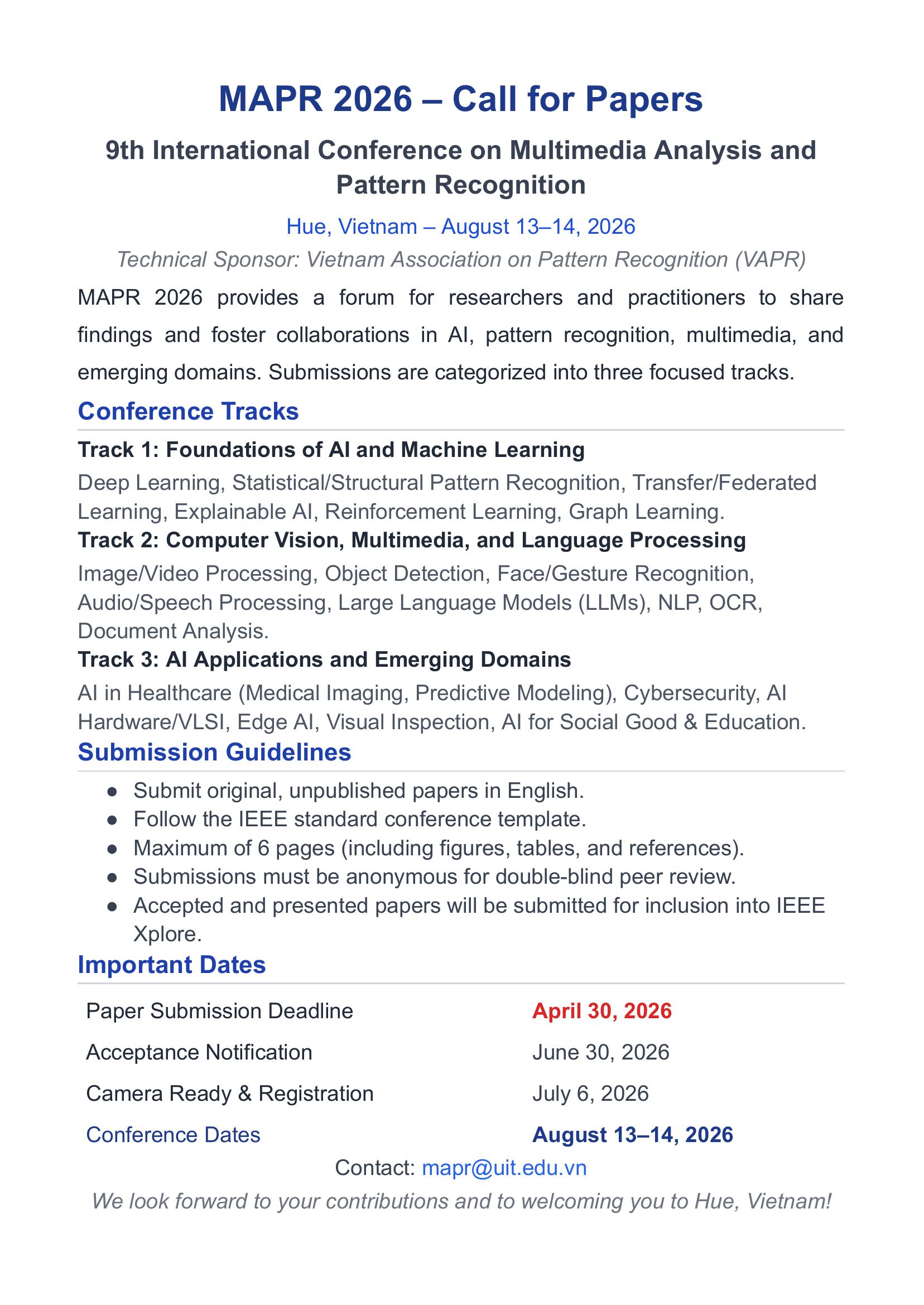
After the success of the 8th MAPR 2025, we are pleased to announce the 9th International Conference on Multimedia Analysis and Pattern Recognition (MAPR), supported by the Vietnamese Association on Pattern Recognition (VAPR). The conference will be held in Hue City, Vietnam, on August 13-14, 2026.
MAPR 2026 provides a forum for researchers and practitioners from academia and industry to share their latest findings and foster collaborations in AI, pattern recognition, multimedia, and emerging application domains. Authors are invited to submit original and unpublished research papers. In 2026, submissions are categorized into three focused tracks to facilitate review and maximize impact.
Conference Tracks & Topics of Interest Please select the most relevant track for your submission. Topics of interest include (but are not limited to):
1. Track 1 – Foundations of AI and Machine Learning
- Statistical, Syntactic and Structural Pattern Recognition
- Machine Learning and Data Mining
- Dimensionality Reduction and Manifold Learning
- Classification and Clustering
- Graphical Models for Pattern Recognition
- Deep Learning
- Pattern Recognition for Big Data
- Transfer Learning
- Federated Learning
- Explainable AI Trustworthy & Ethical AI
- Reinforcement Learning and Planning
- Graph Learning & Knowledge Representation
- Human-in-the-loop and Interactive Learning
Track 2 – Computer Vision, Multimedia, and Language Processing
Computer Vision
- Image and Video Processing
- Image Segmentation
- Object Detection and Recognition (2D/3D)
- Activity and Event Analysis
- Motion Analysis and Tracking
- Scene Understanding Stereo and Multi-view Geometry
- Vision for Robotics
- Face Detection, Tracking, and Recognition
- Gesture and Gait Recognition
- Egocentric and First-person Vision
Multimedia Analysis
- Audio and Speech Processing
- Multimedia Feature Extraction
- Enhancement, Restoration, and Filtering
- Coding, Compression, and Super-resolution
- Multimedia Indexing and Retrieval
- Multimodal Information Fusion & Cross-modal Retrieval
Natural Language Processing (NLP)
- Large Language Models
- Natural Language Understanding and Generation
- Visual Question Answering Dialogue Systems and Conversational AI
- Fact Checking and Verification Sentiment and Emotion Analysis
- Multimodal Language & Vision Integration
- Text Summarization
- Speech and Audio-Text Analytics
Document Analysis & Recognition
- Document Structure and Understanding
- OCR: Character, Text, Handwriting, and Mathematical Expression Recognition
- Table & Form Understanding
- Graphics Recognition
Track 3 – AI Applications and Emerging Domains
AI in Healthcare
- Medical Image Analysis and Computer-aided Diagnosis
- Clinical Data Mining and Electronic Health Records
- Predictive Modeling for Healthcare
- AI-assisted Medical Decision Support Systems
- Privacy-preserving and Federated Healthcare AI
- Wearable Devices and Patient Monitoring
- Biomedical Signal Processing
- Healthcare Chatbots and Virtual Assistants
- Healthcare Operations and Workflow Optimization
- Explainable, Trustworthy, and Fair AI in Healthcare
AI for Cybersecurity
- AI for Threat Detection and Prevention
- User Behavior Analytics
- Fraud Detection and Risk Assessment
- Adversarial Attacks and Defenses
- Digital Forensics
- Vulnerability Management Privacy-friendly AI for Security
AI Hardware, VLSI, and Resource-Constrained Systems
- Hardware-aware Neural Network Optimization
- Low-Power and Energy-Efficient Architectures for Edge and Embedded AI
- Compute-in-Memory (CiM) and Neuromorphic Hardware for AI Acceleration
- AI-Driven Electronic Design Automation (EDA) and Chip Design Automation
- Domain-Specific Architectures (DSA) for Deep Learning Workloads
- Hardware/Software Co-design for Efficient AI Deployment
- Security and Robustness of AI Accelerators at the Circuit Level
Other AI Applications & Emerging Domains
- Visual Inspection & Quality Assessment
- Food and Agriculture Product Quality Assessment
- Mobile and Embedded AI Applications
- Edge AI
- Multimedia Search Engines
- Assistive Technologies (Mobility Aid, Accessibility)
- AI for Social Good & Sustainability
- AI in Education and E-Learning
- Digital Transformation in Society & Business
- AI for Environment & Climate
- Other Innovative Applications
IMPORTANT DATES
- Abstract Submission Deadline: May 10, 2026
- Full Paper Submission Deadline: May 15, 2026
- Paper Acceptance Notification: J
une 30, 2026July 6, 2026 - Camera Ready :
July 6, 2026. July 12, 2026 - Author registration :
July 6, 2026July 12, 2026 - Conference Dates : August 13-14, 2026
PAPER SUBMISSION AND PUBLICATION
Authors are invited to submit anonymous papers in the IEEE standard format, with a maximum of 6 pages including figures, tables, and references. Submissions must conform to the instructions for double-blind review.
Accepted papers will be submitted for inclusion into IEEE Xplore subject to meeting IEEE Xplore’s scope and quality requirements.
CONTACT INFORMATION
Inquiries about the conference should be directed to: mapr@uit.edu.vn